




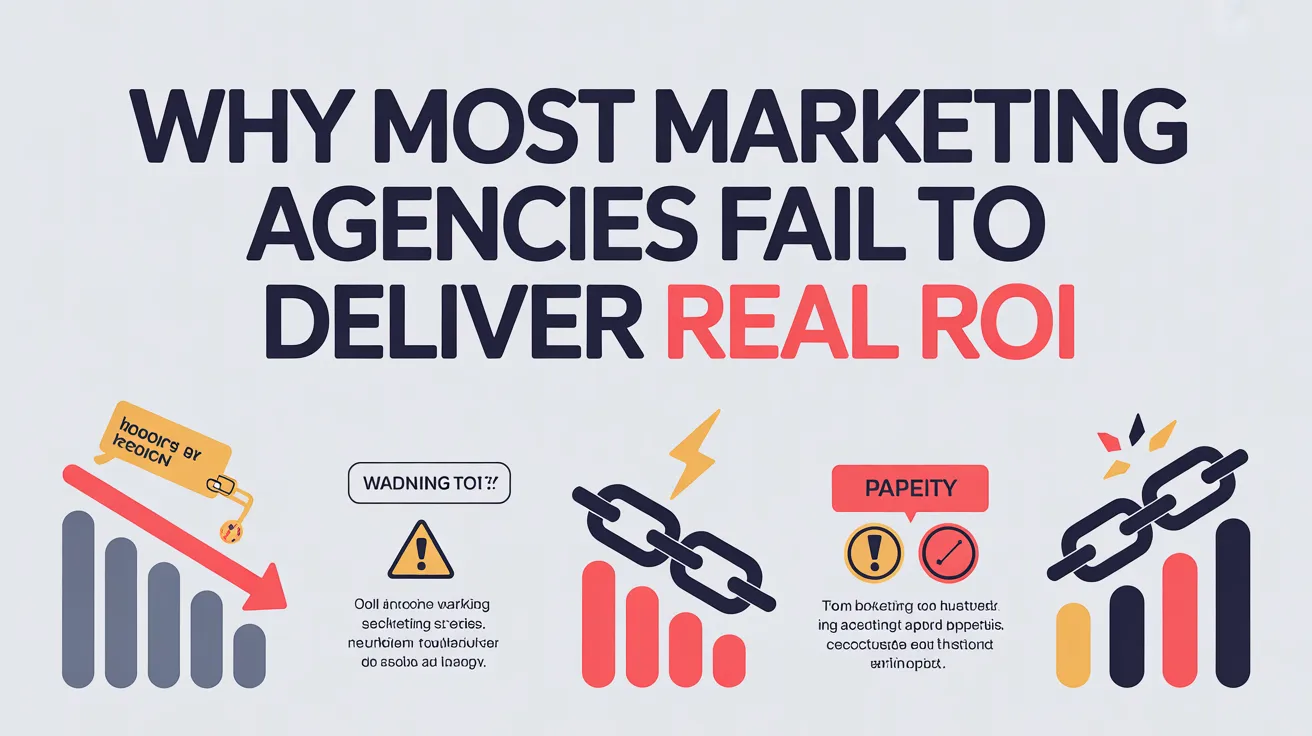
Every month, ambitious brands pour real money into marketing and walk away with nothing but a report they don’t fully understand.
If that hits close to home, a lot of brand owners have felt exactly that. Staring at impressive-looking numbers while quietly wondering why revenue hasn’t moved is one of the most frustrating parts of paid ads eCommerce growth today. The problem isn’t marketing itself. The problem is how most agencies approach it.
The problem isn’t marketing itself. The problem is how most agencies approach it. Let’s break it down.
The Real Reason “ROI” Gets Promised but Never Delivered
Most people assume they hired the wrong agency because of the skill. But that’s rarely the full story. The more profound issue is structure. Most agencies aren’t built to support scalable paid ads eCommerce growth, and that’s where performance starts to break.
Traditional digital advertising agencies are built to manage accounts, not grow businesses. They focus on what they can control: ad setup, campaign management, and reporting. What they don’t focus on is the one thing you actually care about, which is revenue.
Here’s where things go wrong at the foundation level:
- Agencies optimize for activity, not outcomes
- Reports get filled with reach, impressions, and click-through rates that don’t connect to sales
- Strategy is treated as a one-time setup, not a living process
- Your brand gets the same playbook used on the last five clients
Does this sound familiar? It should. Because this approach is the standard operating model for most agencies, and it’s exactly why so many brands keep switching and still end up disappointed.
They Use One Strategy for Every Brand
Imagine you walk into a doctor’s office. Without asking a single question, the doctor hands you a prescription. It is the same one that was given to the last patient. Would you trust that?
That’s exactly what happens with cookie-cutter agency strategies.
Your brand has specific customers, a specific product story, and a specific competitive landscape. When an agency resorts to its default playbook, they neglect to consider any of these factors.
What successful eCommerce growth marketing actually looks like:
- Deep analysis of your historical data before a single ad goes live
- Understanding your unit economics: cost per acquisition, lifetime value, profit margins
- A Facebook ads scaling strategy designed for your audience’s actual behavior
- Creative that reflects your brand’s real voice, not recycled formats
At Pixel Theory, no two strategies look the same. Every partner gets a custom roadmap built from real data and real market insight. This is not a template with your logo.
Creative Gets Ignored Until It’s Too Late
Here’s a scenario you might recognize. The first month of ads goes really well. You’re excited. Then slowly, results start to drop. You ask the agency what’s happening. They suggest increasing the budget. You do. Results keep dropping anyway.
What actually happened? Creative fatigue.
Your audience saw the same ad too many times and stopped responding. Instead of refreshing creativity, the agency just kept running what was already there.
Why creative strategy matters so much for paid ads, eCommerce growth:
- Audiences tune out repetitive ads fast, sometimes within two to three weeks
- Testing UGC, direct response video, and high-production assets shows you what actually converts
- Ad copy and visual hooks need to evolve as your market shifts
- New creative angles reveal what resonates with your specific buyers
Pixel Theory’s creative marketing campaigns aren’t a one-time delivery. They’re a continuous testing process with new angles, new formats, and new messages built around what the data says is working right now.
The Channels Don’t Talk to Each Other
This is a structural problem inside most digital advertising agencies, and it quietly destroys performance.
The person running your paid media doesn’t coordinate with the person writing your ad copy. The creative team doesn’t talk to the landing page team. Everyone’s in their own lane, and the result is a broken customer journey.
Someone clicks your ad. The message doesn’t match the landing page. The offer doesn’t match the creative. They leave. And you paid for that click.
What a connected system looks like instead:
- Paid media, creative, and CRO work as one performance engine
- Every part of the customer journey reinforces the same message
- Landing pages are built to convert the specific audience the ad targets
- Attribution modeling tracks which touchpoints actually drove the sale
Lorraine Ruiz, CEO of Ancient Crunch and a Pixel Theory partner, put it plainly: “They don’t treat media, creative, and CRO as separate lanes. They build them into a single performance system.”
That’s the difference between an agency running campaigns and a growth partner building real outcomes.
Book Your Free Strategy Call Today, and let’s find where your current setup is losing money.
They’re Always Planning. Never Moving.
You’ve probably sat through an agency kickoff that felt more like a documentary about your brand than an action plan. Three-month roadmaps. Approval stacked on approval. Meanwhile, your competitors are already live, testing, and learning.
Speed isn’t about being reckless. It’s about treating every campaign as a live experiment where real feedback beats a polished strategy deck.
How real paid ads for eCommerce growth work in practice:
- Campaigns launch fast, so data starts coming in immediately
- What’s working gets more budget right away, not in the next quarterly review
- What isn’t working gets cut without ceremony
- Strategy adapts in real time based on what the market is telling you
This is what “ruthless optimization” means in practice. Not a philosophy on a website. A daily operating mode.
What Separates a Growth Partner from Just Another Agency
Not every agency that calls itself a performance marketing agency is actually operating like one. The label doesn’t mean much if the behavior looks the same.
| Traditional Agency | Real Growth Partner |
| Focuses on campaign management | Focuses on revenue outcomes |
| Reports on activity metrics | Tracks CAC and ROAS |
| Applies generic strategies | Builds custom data-driven roadmaps |
| Treats creative as a deliverable | Treats creative as an ongoing test |
| Moves slowly through approvals | Launches fast, adjusts faster |
| Manages channels in isolation | Connects paid media, creative, and CRO |
A Facebook ads scaling strategy that actually works is never accidental. It’s built, tested, and rebuilt until the numbers prove it’s right. Pixel Theory has helped scale over 50 brands and generated $900 million in revenue for partners across industries. That doesn’t come from managing accounts. It comes from treating paid ads for eCommerce growth as an engineered system, not a managed service.
The Right Partner Makes All the Difference
You’ve built something worth growing, and you’re putting real money into marketing. The least you deserve is a partner who treats that budget like it actually matters, not one that sends activity reports and calls them results.
Before you hire any agency, ask them straight: do they study your unit economics before building a strategy? Do their paid media, creative, and CRO teams actually work together? If they can’t answer those questions clearly, you already know what the results will look like.
See How We Generate Real Results for brands ready to stop playing small.
Questions Brands Ask Before Making the Switch
1. What should I actually expect from a performance marketing agency in terms of ROI?
Expect clear improvements in your cost per acquisition and return on ad spend within the first few months. Your agency should proactively share what’s working and what isn’t, without you having to ask.
2. Why do my Facebook ads perform well at first and then fall off?
It’s almost always creative fatigue. A real Facebook ads scaling strategy means refreshing creatives and testing new angles before performance drops, not scrambling to fix things after.
3. How do I know if my agency is scaling my brand or just managing it?
If ad spend grows, but your cost per acquisition isn’t improving, they’re managing. Real paid ads eCommerce growth means your unit economics get better as your budget increases, not worse.
4. What makes Pixel Theory different from other digital advertising agencies?
Unlike most advertising agencies, Pixel Theory connects paid media, creative, and CRO into one performance system. With 50+ brands scaled and $900 million in revenue generated, the focus is always on growth, not just activity.